


Understanding HCM in Cats

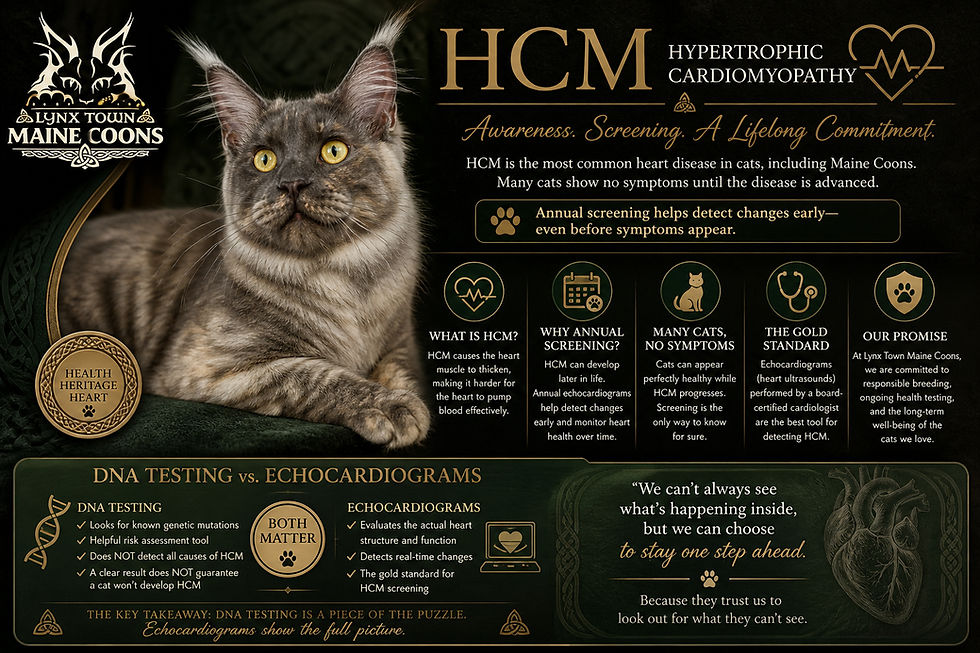
Why Annual Screening Matters—From a Breeder Who Lives It
If you’ve spent any time with a Maine Coon, you already know—they’re not just pets. They’re companions, personalities, and in many cases… a little larger-than-life in every way.
Because I live and work with these cats every day, one topic I take very seriously—and talk about often—is Hypertrophic Cardiomyopathy (HCM).
Not to scare anyone, but to educate, empower, and advocate.
What is HCM?
Hypertrophic Cardiomyopathy (HCM) is the most common heart disease found in cats.
It causes the muscular walls of the heart to thicken, which can interfere with the heart’s ability to pump blood effectively.
What makes HCM especially tricky is this:
Many cats show no signs at all—until they do.
Some cats may go their entire lives without symptoms, while others may experience:
Decreased activity or subtle lethargy
Rapid or labored breathing
Sudden collapse
Or, in the most heartbreaking cases, sudden death
It’s unpredictable—and that’s exactly why screening matters.
Why Annual Screening is So Important
One of the biggest misconceptions I see is this idea that a “clear” result once means a cat is in the clear for life.
Unfortunately, that’s not how HCM works.
HCM can develop later—even in previously healthy cats.
That’s why annual screening is considered best practice, especially in breeds like Maine Coons.
The most effective way to screen for HCM is through an echocardiogram—an ultrasound of the heart performed by a veterinary cardiologist.
This allows specialists to:
See the heart in real time
Measure wall thickness
Detect early or subtle changes
Track progression over time
Even when everything looks perfect on the outside, this test can catch what we otherwise wouldn’t see.
DNA Testing vs. Echocardiograms: What’s the Difference?
This is where things can get a little confusing, so let’s break it down simply.
DNA Testing
DNA testing looks for known genetic mutations associated with HCM in Maine Coons.
It’s a helpful tool—but it has limitations.
It can identify certain risk markers
It does not detect all possible causes of HCM
A “clear” DNA result does not guarantee a cat won’t develop HCM
Echocardiograms (Heart Ultrasound)
An echocardiogram evaluates the actual heart structure and function.
Detects real-time changes in the heart
Identifies disease even without known genetic markers
Considered the gold standard for HCM screening
The key takeaway: DNA testing is a piece of the puzzle. Echocardiograms show the full picture.
Responsible programs—and informed owners—use both.
What Responsible Breeding Looks Like
At Lynx Town Maine Coons, this isn’t just a checklist—it’s a commitment.
That includes:
Routine HCM screening of breeding cats
Continued monitoring as cats mature
Understanding that results can change over time
Making thoughtful (and sometimes difficult) decisions when needed
Because at the end of the day, this isn’t just about breeding.
It’s about doing right by the cats—and the families who love them.
What This Means for You as a Cat Owner
Whether your cat comes from a breeder or not, this information matters.
If you have a Maine Coon or a cat at higher risk, consider:
Talking with your veterinarian about HCM screening
Establishing a baseline echocardiogram
Following up periodically as your cat ages
Paying attention to subtle changes in behavior or breathing
You don’t need to panic—but being proactive is powerful.
Final Thoughts
If there’s one thing I hope you take away from this, it’s this:
A healthy-looking cat isn’t always a heart-healthy cat.
And that’s not meant to worry you—it’s meant to remind you that the best care often happens quietly, behind the scenes.
Annual HCM screening is one of the most meaningful ways we can advocate for the long-term health of these incredible cats.
Because they trust us to look out for what they can’t see.
🐾 From Lynx Town
As someone who lives this every day—showing, raising, and loving these cats—this is one of the ways I work to protect the future of the breed and support the families who welcome them home.
If you ever have questions about HCM, screening, or your own cat, I’m always happy to talk.


Comments